Somewhere in a churchyard in Massachusetts, there’s a slate marker from the 1680s. The carving is crisp still — a death’s-head motif, winged skull above a name and two dates, the format so standardized across colonial New England that you could walk from grave to grave and read the visual language instantly. That was the point. Memorial culture in early America was public. Communal. The marker wasn’t for the individual. It was for the community’s understanding of death itself.
American grave headstones have traveled a long way from that.
The 19th century brought marble — softer, whiter, more sculptural than slate, producing the flowing draped urns and weeping willows of Victorian cemetery art. Then came the problem: marble weathers. The 1870 stone that looked like a classical monument in 1900 had become a barely-legible slab by 1970. The shift toward granite wasn’t stylistic. It was material logic. Dense granite, properly quarried, doesn’t absorb moisture the way marble does. It resists spalling in freeze-thaw cycles. It holds its engraving for a century or more without restoration.
By the mid-20th century, polished black granite — most commonly Indian Black from Andhra Pradesh — had become the dominant American memorial material. The deep surface and high contrast for white-engraved text proved so consistent that the stone found its way into national cemetery standards, into military sections from Arlington National Cemetery in Virginia to Fort Sam Houston in Texas, and eventually into the baseline expectation for what a grave headstone looks like.
But the form kept evolving.
Flat markers — flush with the ground, or just barely above it — grew from a practical cemetery maintenance solution into an aesthetic preference. Modern memorial parks in California and Florida adopted them as the standard because they allowed consistent mowing and landscaping without the visual fragmentation of rows of different-height stones. The lawn cemetery format, first developed in the late 19th century by landscape architect Adolph Strauch, was premised on the idea that a burial space could be peaceful and beautiful rather than architecturally complicated. The flat grave headstone is that philosophy rendered in stone.
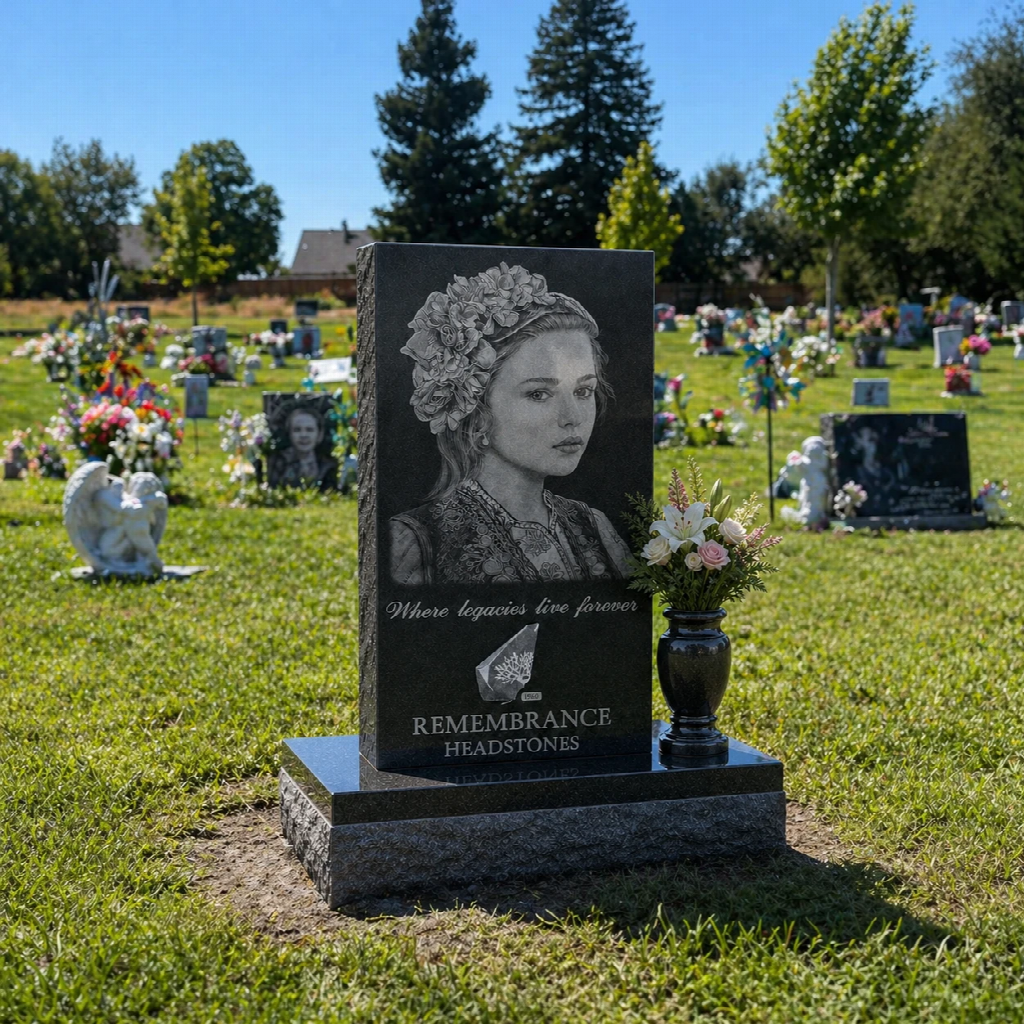
The upright monument, by contrast, never left. It remains the dominant form in traditional Catholic sections throughout Pennsylvania, Ohio, New Jersey, and Illinois. It’s the default in Jewish cemeteries across New York and New Jersey, where the upright tablet with Hebrew text carries religious and community significance that goes beyond aesthetics. Military sections in national cemeteries use upright white marble tablets — regulated in dimensions, font, and layout — not because the form is contemporary but because the uniformity of upright stones at Arlington and in national cemeteries carries its own meaning. Every grave equally marked. No variation in height or presence.
The forms that get less attention — slant headstones, bevel markers, ledger stones, bench memorials — carry equally specific histories. Bench memorials come from the 19th century European tradition of the graveside seat, a place to sit in extended mourning. American families are returning to this form in large numbers now, though often with different intent: less extended mourning than a designated gathering place. Something to come back to. Somewhere to sit while talking to the person who isn’t there.
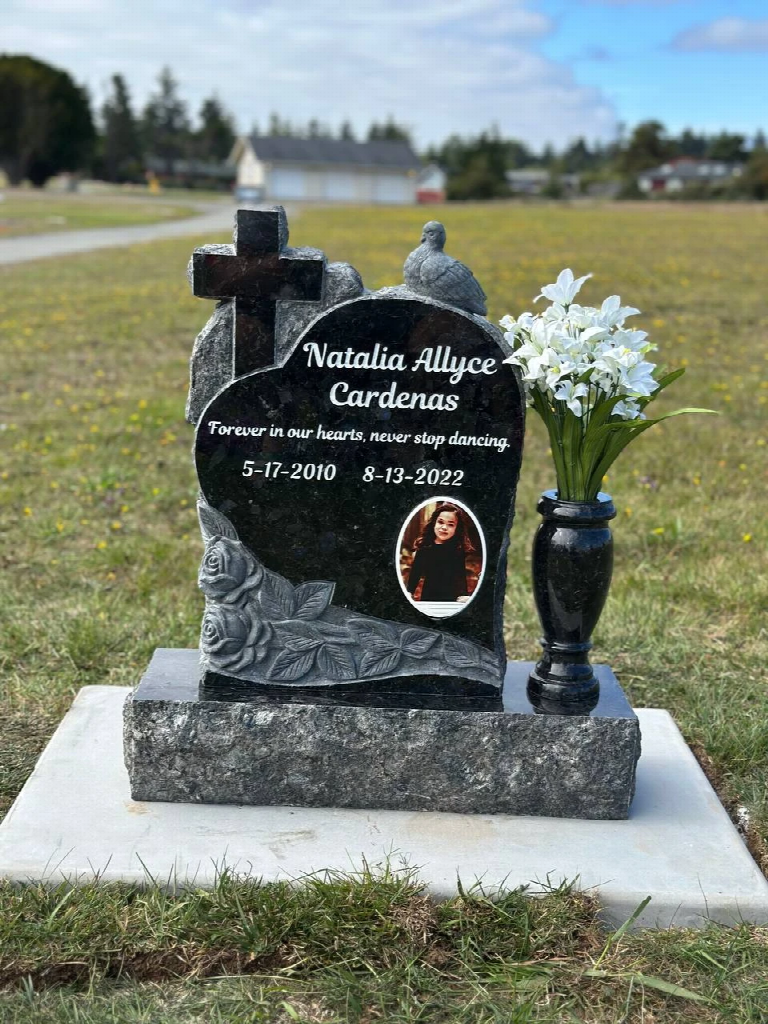
Cemetery vases — the stone or metal fixtures anchored beside a marker — trace their own history through both Mediterranean and Northern European traditions. In Italian-American cemeteries in New York and New Jersey, the filled vase is practically obligatory. In Chinese-American memorial sections in California, specific flowers carry meaning aligned with the occasion. In Southern Baptist cemeteries across North Carolina and South Carolina, fresh-cut flowers brought on a Sunday are replaced with artificial arrangements for winter months when nothing blooms locally.
What none of this history answers is the question families actually face: what do I choose, and why.
The contemporary answer involves more options than any previous generation had. Custom shapes — hearts, crosses, trees, animals, cultural symbols — are achievable in granite with precision that previously required exceptional hand-carving skill. Portrait etchings are laser-engraved directly into the stone surface. 3D design tools let families preview the finished memorial in full render before production begins. The stone that marks a grave in 2025 can carry more personal information about a specific individual than anything the 19th century could produce.
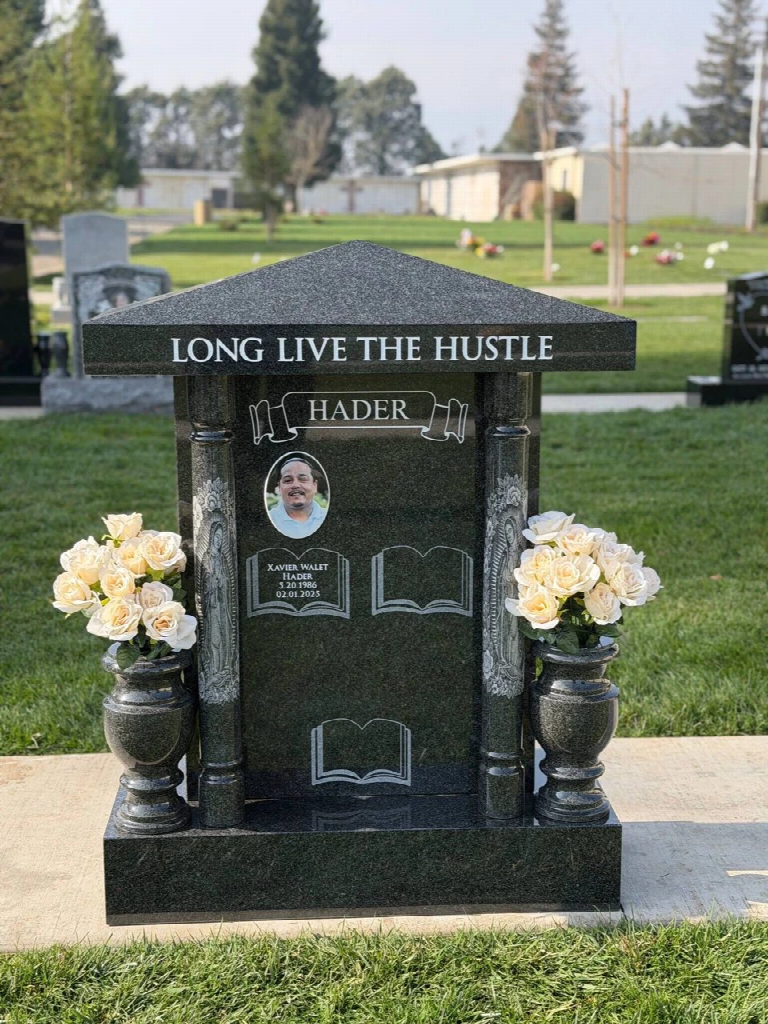
The question of material remains the same as it’s been since granite replaced marble: what will still be there in fifty years?
The answer to that question hasn’t changed. Dense, polished granite from quality quarries — maintained not by resealing or painting but simply by its own material properties — will still be there. Still readable. Still present at the grave.
For families navigating this process now, across states from Washington and California to Texas, Oklahoma, Illinois, Ohio, and the Northeast, the combination of material quality, transparent pricing, and complete installation service — from design through cemetery coordination — is available from manufacturers who have built their systems specifically around that experience.
Remembrance Headstones offers exactly that model, with 14 showrooms, over 40 granite types, and a lifetime guarantee on every piece. Start at remembranceheadstones.com.