There is a moment at the end of the line that none of us has gotten used to, and I hope we never do.
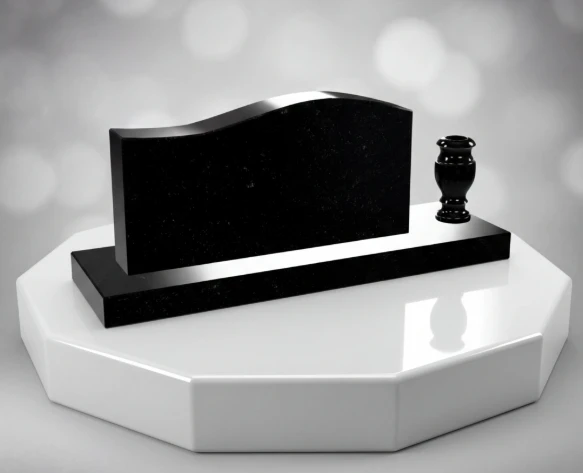
The stone comes off the final polishing stage, the inspection team checks the letter edges under raking light, someone wipes the face down one last time — and for a few seconds, before it gets crated for delivery, the finished upright stands there in the facility. A name. Two dates. Maybe a carved angel, maybe a tree with birds, maybe just clean Roman capitals on Indian Black. And every person on that floor knows what we are looking at. Not inventory. The single object that will represent an entire human life, outdoors, in public, for the next hundred years.
Also Read: Best Mid-Century Modern Floor Lamps 2026
We manufacture across twenty product categories, but upright headstones for graves are the work that carries the most weight in the building — figuratively and literally. The standing format is the most visible thing in any cemetery. It reads from the path. It casts a real shadow. Whatever we get right or wrong on that vertical face will be seen by every person who walks past it for generations, which is a quality bar no other product we know of has to meet.
So let me explain what actually goes into one, because most families never see this part.
It starts at the quarry, not the design screen. We source directly — India, China, Norway, Finland, Brazil — and the difference between quarry-direct and broker-supplied stone is not a marketing line, it is measurable. Density. Grain consistency. Moisture absorption. An upright is a structural object: four to eight inches of granite standing in weather, anchored in a foundation, resisting wind load and frost heave in places like Ohio, Pennsylvania, and upstate New York. Stone that absorbs water fails slowly and invisibly until one winter it doesn’t. Every batch through our facility passes a six-stage quality inspection, and density verification is not the stage we skip.
Then the shape. The top edge of an upright is the first design decision and the one families underestimate. A flat top is institutional and calm. A rounded top is the American default, soft and familiar. An arch carries Gothic weight that suits Catholic and Orthodox sections in Chicago, Philadelphia, Cleveland. Ogee curves read personal. And then there are the shaped tops — the cross silhouettes, the heart forms, the Tree Shape Upright with Birds that one of our teams still talks about, the pagoda profiles for Asian-style sections. The silhouette is the stone’s voice before anyone reads a word on it.
Relief carving is the capability that belongs to this format alone. A flat marker cannot carry raised imagery; an upright can. Our Angel Prayer Relief — a bowed figure, hands clasped, raised from the stone face — casts actual shadows into its own recesses when afternoon light comes across it at an angle. That dimensionality is not reproducible by etching. It is sculpture, done by CNC and finished by hand, and it is the reason families who want a figure rather than a picture of a figure end up in the upright category.
Companion uprights deserve their own mention because they are the most emotionally complicated pieces we make. Two inscription panels, one stone, a central image that belongs to both people at once — swans facing each other, a shared verse, interlocking forms. Often one panel is filled and one waits. We produce those knowing exactly what the empty panel means, and I will be honest: the orders where a surviving spouse approves the design with their own name already placed on it are the ones that stay with our design team longest.
The proofing process is where the last twenty years changed everything. We render the complete stone in 3D on the actual granite the family selected — not a text layout on white, the real surface, the real color, the real proportions. The AR view then places the finished upright at true scale wherever the family points a phone. Scale is the historic failure point of this format; a stone that looked right on paper reads oversized or undersized at the grave, and there is no fixing that after installation. The preview ended that problem for our customers, and honestly we think it should be the industry standard everywhere.
Cemetery coordination is ours, not the family’s. Every cemetery — sometimes every section — has its own rules on height, base dimensions, foundation type. We contact the location before production starts, submit the documentation, schedule the foundation pour, and install with our own certified crews. Families in Sacramento and Houston who visit our showrooms hear this in person; families in Kansas, Arkansas, South Carolina, and other states ordering entirely online get exactly the same coordination. The stone does not leave our hands until it is standing, level, where it belongs.
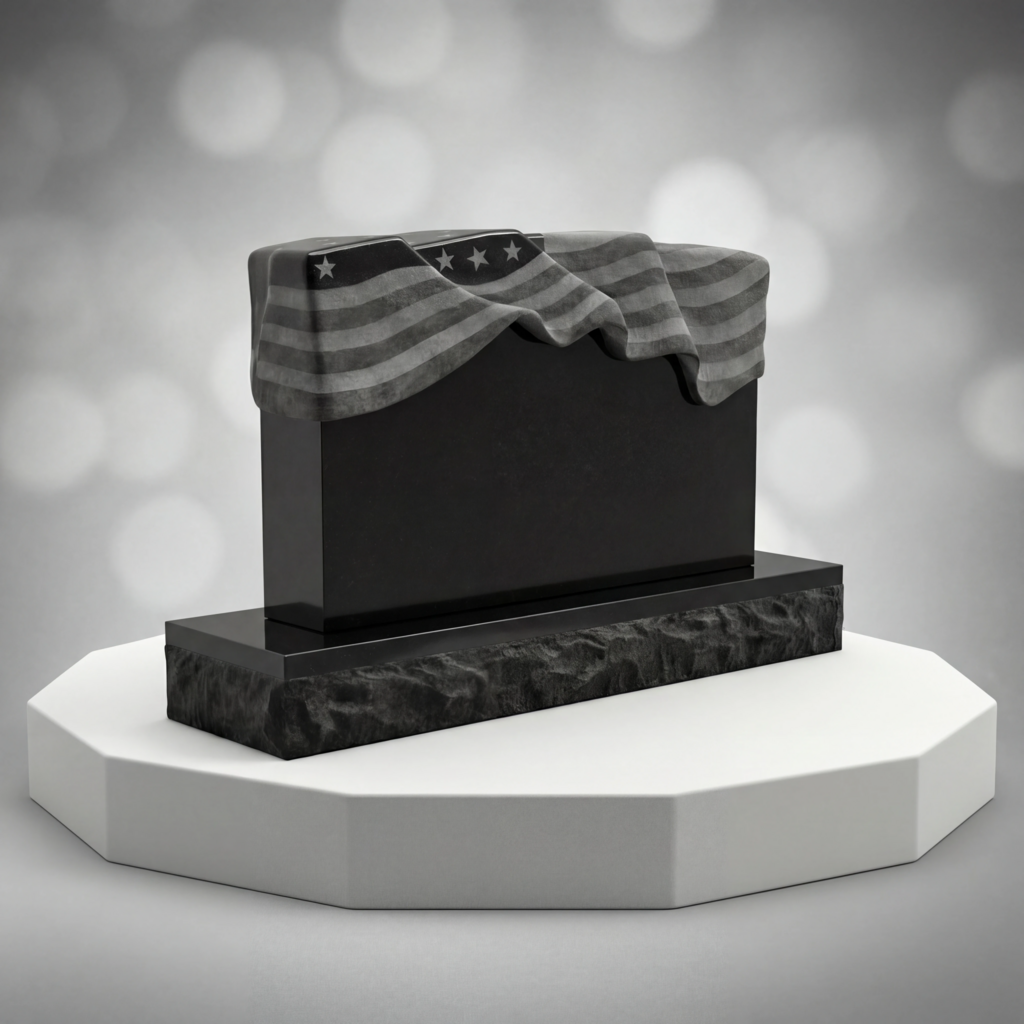
The numbers, plainly: compact single uprights start at $2,240, complete — stone, all engraving, design proof, delivery, coordination. Companion and relief-carved pieces scale from there. Veterans receive 30% off with full payment. Police officers and first responders, 25%. In-house 0% financing runs twelve months with no background credit check, Klarna to twenty-four, pre-need plans to thirty-six. A lifetime guarantee stands behind every stone, which is an easy promise to make when you controlled the granite from the quarry forward.
Fourteen showrooms across eight states — California, Texas, Oklahoma, Florida, North Carolina, Illinois, New Jersey, Washington — carry polished samples, because Blue Pearl next to Balmoral Red in natural light is a comparison no screen can give you. After-hours appointments at every location.
But the thing I keep coming back to is that moment at the end of the line. The stone standing there, finished, waiting for the crate. Somebody’s whole life, about to go stand in the weather for a century. We take that seriously every single time, because there is no version of this work where you get to take it lightly.
See the full upright catalog, every granite type, and the 3D and AR design tools at hstones.com.